Purchase confirmed.
Your download links are on their way. Check your email now.
Links expire in 24 hours. Save your files once downloaded.
Gratitude, Examined
Count What Counts
What the research says about gratitude: the classic blessings experiment, happiness exercises that lasted, a meta-analysis that checked the comparison groups, a larger review, gratitude at work, sleep, the body, and thanks between people. Twenty-one research chapters that name each study and its size, plus a weekly routine, drills with answer keys and cards to copy. General education, not treatment.
24 chapters · 58 pages · 25 studies cited
PDF + Kindle ePub · Instant download · 30-day money-back guarantee
Buy Count What Counts — $14.99Secure checkout via Stripe
What you get
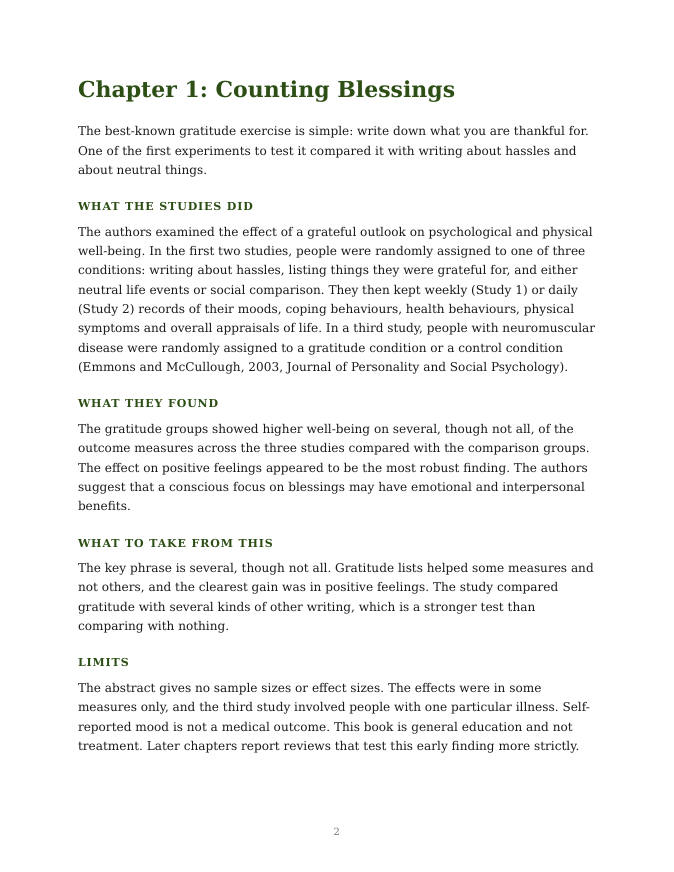
Counting Blessings
The classic experiment: gratitude lists raised well-being on several but not all measures, and positive feeling most clearly.
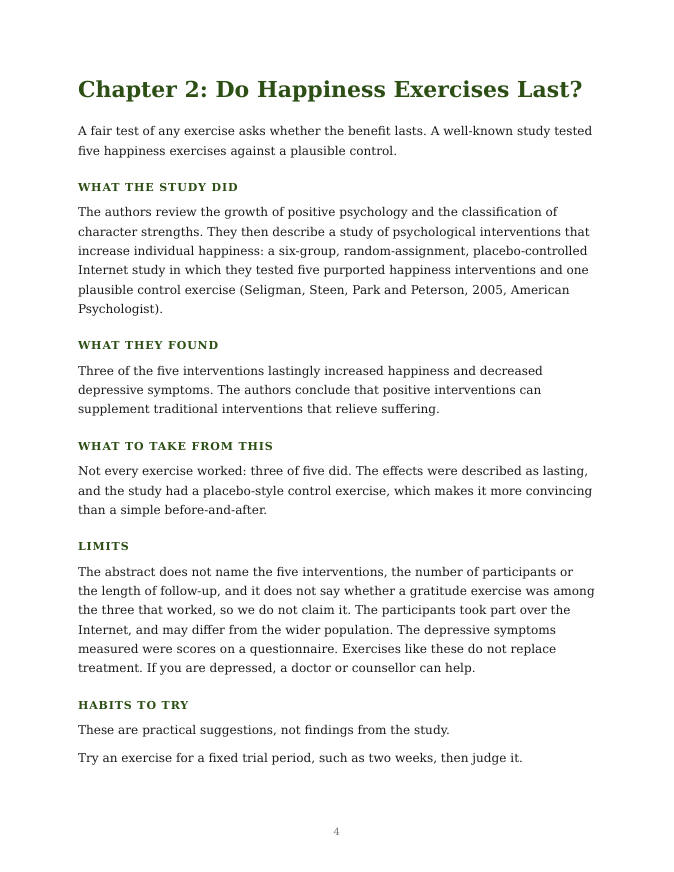
Do Happiness Exercises Last?
A six-group placebo-controlled Internet study: three of five exercises lastingly raised happiness.
A Meta-Analysis With a Reality Check
Small gains over doing nothing, a very small gain over a matched activity and no edge over an active alternative.
The Larger Review
64 randomised trials: more gratitude, better mental health and fewer anxiety and depression symptoms, as a complement to treatment.
Gratitude at Work
Nine trials of workers: less stress and depression with lists, but not when there were four lists or fewer.
Gratitude and Sleep
A survey of 401 people and a two-week experiment with 119 young women: better sleep and lower diastolic blood pressure.
Health Behaviours and the Body
19 trials: sleep improved in 5 of 8 studies, other results came from single studies.
Thanks Between People
Expressing thanks to a friend or partner strengthened how people saw the relationship, and appreciation went with commitment.
Counting Blessings at School
221 early adolescents in 11 classes: more gratitude, optimism and life satisfaction, and most strongly satisfaction with school, still there at three weeks.
Gratitude and Helping
Three experiments: felt gratitude increased costly helping, and the spillover to strangers faded when people saw the real cause.
A Pilot Trial With Teenagers Who Have Type 1 Diabetes
80 teenagers: no difference on psychological measures, a borderline glucose result after adjustment, and an honest null.
A Ten-Week Journal for Students in a Crisis
87 students during the pandemic: well-being rose with ten weekly journals while the comparison group fell (d = 0.74).
Happiness Exercises: A Big Early Claim
51 interventions and 4,266 people: well-being (r .29) and depressive symptoms (r .31) improved.
A Second Look, With Smaller Numbers
39 randomised studies and 6,139 people: small effects of 0.34, 0.20 and 0.23, with signs of publication bias.
A Reanalysis: The Effects Are Much Smaller
Once small-sample bias was handled, the effect on well-being was about r .10 and on depression often not significant.
A Gratitude Diary for Health Workers
102 practitioners in five hospitals: four weeks of diaries went with lower stress and depressive symptoms at three months.
After a Heart Event: Optimism or Gratitude?
164 people after acute coronary syndrome: optimism, but not gratitude, went with more activity and fewer readmissions.
Gratitude and the Heart: A Small Trial and a Review
A pilot of 70 patients and a review of 19 trials of gratitude and heart-related measures.
Does Kindness Pay Off?
A meta-analysis (K 201, N 198,213): a modest link of r .13 between helping others and well-being.
Kindness in the Classroom
19 classrooms, children aged 9 to 11: three kind acts a week raised peer acceptance.
When Your Partner Says Thank You
Five studies: a partner's perceived thanks buffered the harm of attachment insecurity on satisfaction.
A Practice Routine
Five if-then plans and a light weekly routine that turn the book into habit.
Drills: List, Say, Compare
Specific or vague, the three-part list, saying thanks aloud, reading the numbers, claim checks and a fair comparison, with checked answers. Practice material, not research.
Tools and Glossary
A list card, thank-you script, Friday round card, weekly score card, checklist and a glossary of 17 terms. Practice material, not research.
What makes this different
Every research claim names its study
Each research claim names the study and its size where the abstract gave it. A Sources section lists all 25.
The strict reviews are in
The book reports the small effects, the lack of an edge over other active programmes and the friendlier larger review, side by side.
Cards and drills you can use today
A list card, a thank-you script, drills with answer keys and a score card, labelled as practice material. Not treatment.
Read the first 3 chapters free
Download chapters 1 to 3 before you decide. No email required.
Download free chapters (PDF)Look inside
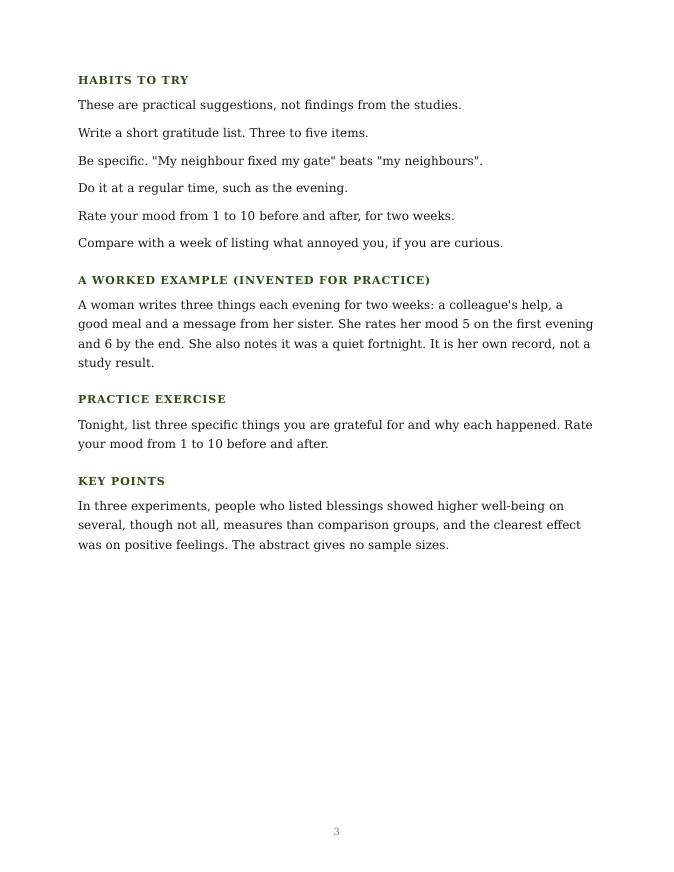
Real pages from Count What Counts
These pages come straight from the free chapter. The full workbook is written the same way.
Questions before you buy
What do I get?
The full book as a PDF and as an ePub for Kindle and Apple Books. One purchase, one flat price, no subscription.
How do I receive it?
You pay on a secure Stripe checkout page. The download link is sent to your email right after purchase.
What if it is not right for me?
You get a full refund within 30 days of purchase, no questions asked. Email the address in your confirmation message.
Can I read a sample first?
Yes. Get Chapter 1 free by email and read it before you decide.
Get Count What Counts
PDF + ePub. Instant download. 30-day guarantee.
$14.99Buy Count What Counts — $14.99Secure checkout via Stripe. 30-day money-back guarantee.