Purchase confirmed.
Your download links are on their way. Check your email now.
Links expire in 24 hours. Save your files once downloaded.
Friendship and Connection, Examined
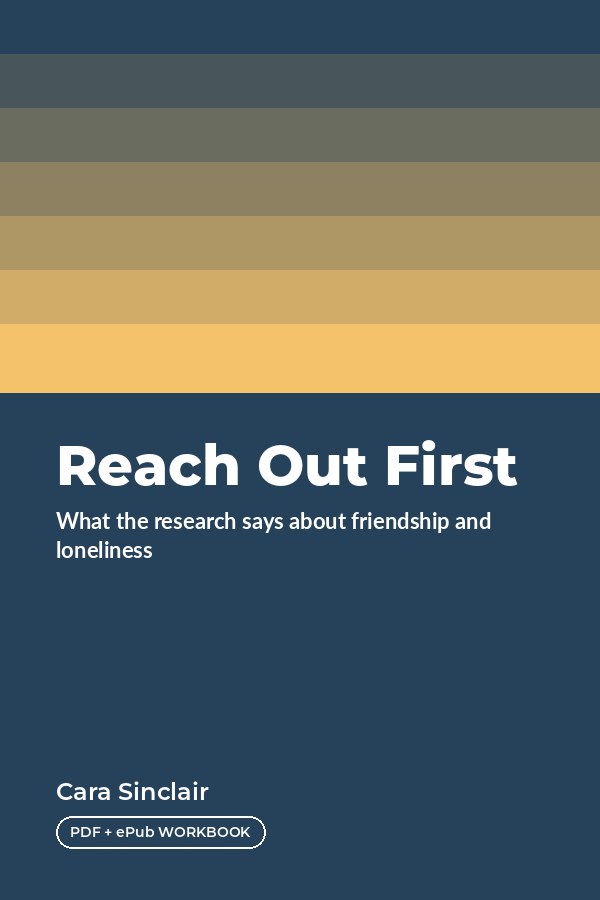
Reach Out First
What the research says about friendship, loneliness and making contact: social relationships and survival, friendship and wellbeing, weak ties, the liking gap, thank-you notes and compliments, reaching out, ending conversations, loneliness treatments and social media. Eleven research chapters that name each study and its size, plus a weekly routine, drills with answer keys and a toolkit with messages to copy.
14 chapters · 36 pages · 14 studies cited
PDF + Kindle ePub · Instant download · 30-day money-back guarantee
Buy Reach Out First — $14.99Secure checkout via Stripe
What you get
Why Connection Counts
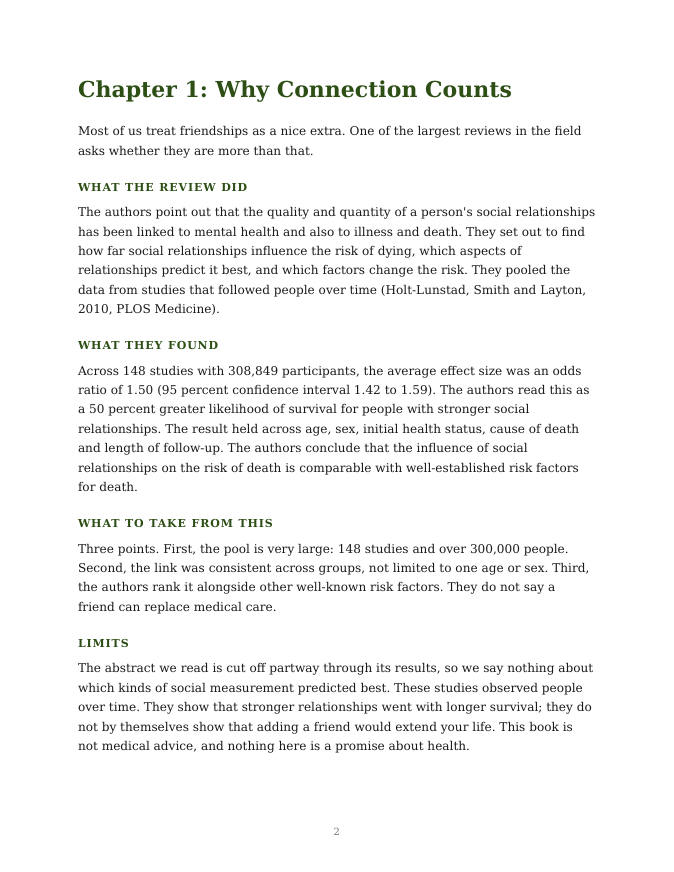
A pooled analysis of 148 studies and 308,849 people: stronger social relationships and survival, and what the link does and does not show.
Friendship and Wellbeing
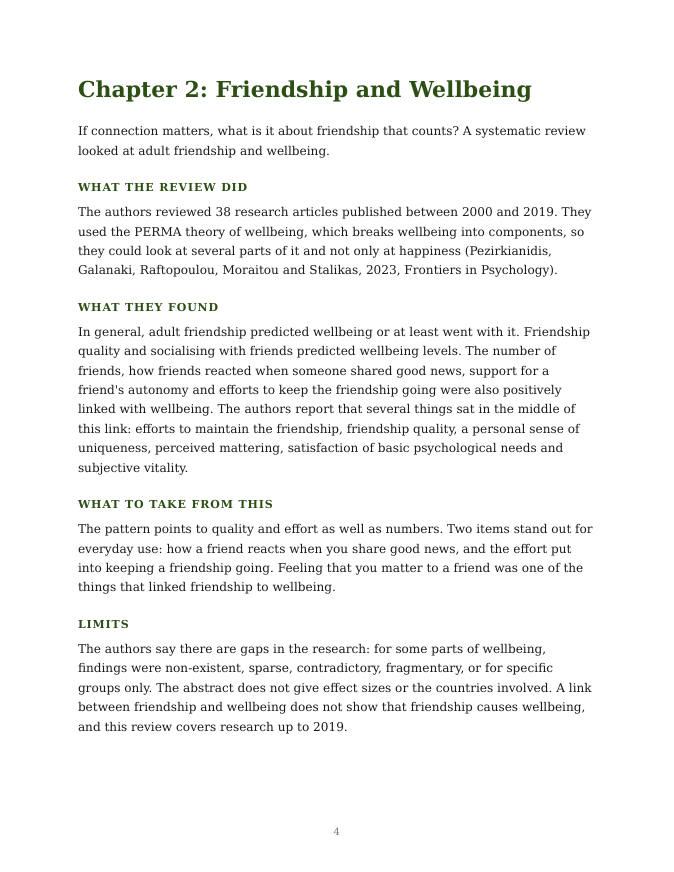
A review of 38 articles: quality, effort, good-news responses and feeling that you matter.
The Power of Weak Ties
Studies of daily life: more happiness and belonging on days with more contact with acquaintances.
Mistakenly Seeking Solitude
Experiments on trains, buses and in a waiting room: people expected solitude to feel better and found the opposite.
The Liking Gap
After a conversation, people systematically underestimated how much their partners liked them, for months.
Saying the Kind Thing: Gratitude and Compliments
Twelve experiments in which givers underestimated how positive and overestimated how awkward it would be.
Reaching Out
Preregistered experiments: people underestimate how much others appreciate being contacted, most for distant ties.
When Conversations End
932 conversations: they almost never ended when both people wanted them to.
Do Treatments for Loneliness Work?
A review of 31 randomised trials: a small to medium effect (g = 0.43), with wide variation.
Loneliness in Later Life
Two reviews of older adults: mostly small effects, uncertain large ones and very low quality evidence.
Does Social Media Help or Hurt?
A meta-analysis of 19,134 observations: no significant overall link in older adults, with a twist before COVID-19.
A Practice Routine
Five if-then plans and a light weekly routine that turn the book into habit.
Drills: Predict, Reach, Check
Prediction logs, message rewrites, thank-yous, closing lines, reading the numbers and claim checks, with checked answers. Practice material, not research.
Tools and Glossary
A message bank, contact list, log, one-page checklist and a glossary of 14 terms. Practice material, not research.
What makes this different
Every research claim names its study
Each research claim names the study and its size where the abstract gave it. A Sources section lists all 14.
Evidence kept apart from advice
Suggestions and invented examples are labelled as practice material, and the book says where a link is not a cause.
Messages and drills you can use today
A message bank, drills with answer keys and a log, labelled as practice material, not research.
Read the first 3 chapters free
Download chapters 1 to 3 before you decide. No email required.
Download free chapters (PDF)Look inside
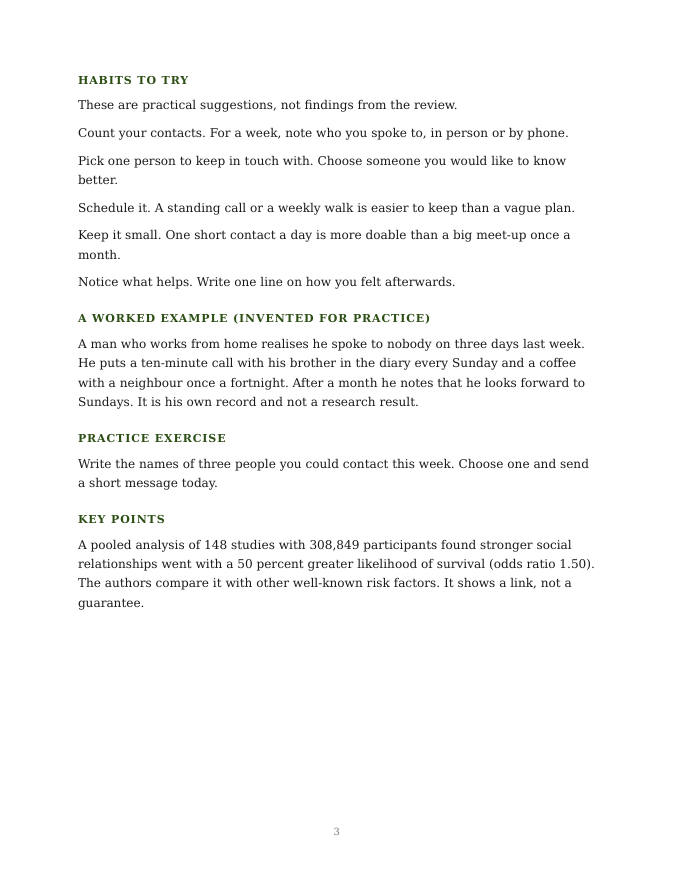
Real pages from Reach Out First
These pages come straight from the free chapter. The full workbook is written the same way.
Questions before you buy
What do I get?
The full book as a PDF and as an ePub for Kindle and Apple Books. One purchase, one flat price, no subscription.
How do I receive it?
You pay on a secure Stripe checkout page. The download link is sent to your email right after purchase.
What if it is not right for me?
You get a full refund within 30 days of purchase, no questions asked. Email the address in your confirmation message.
Can I read a sample first?
Yes. Get Chapter 1 free by email and read it before you decide.
Get Reach Out First
PDF + ePub. Instant download. 30-day guarantee.
$14.99Buy Reach Out First — $14.99Secure checkout via Stripe. 30-day money-back guarantee.